



Countries Requiring Rabies Titer Test for Pets
August 9th, 2026 | Uncategorized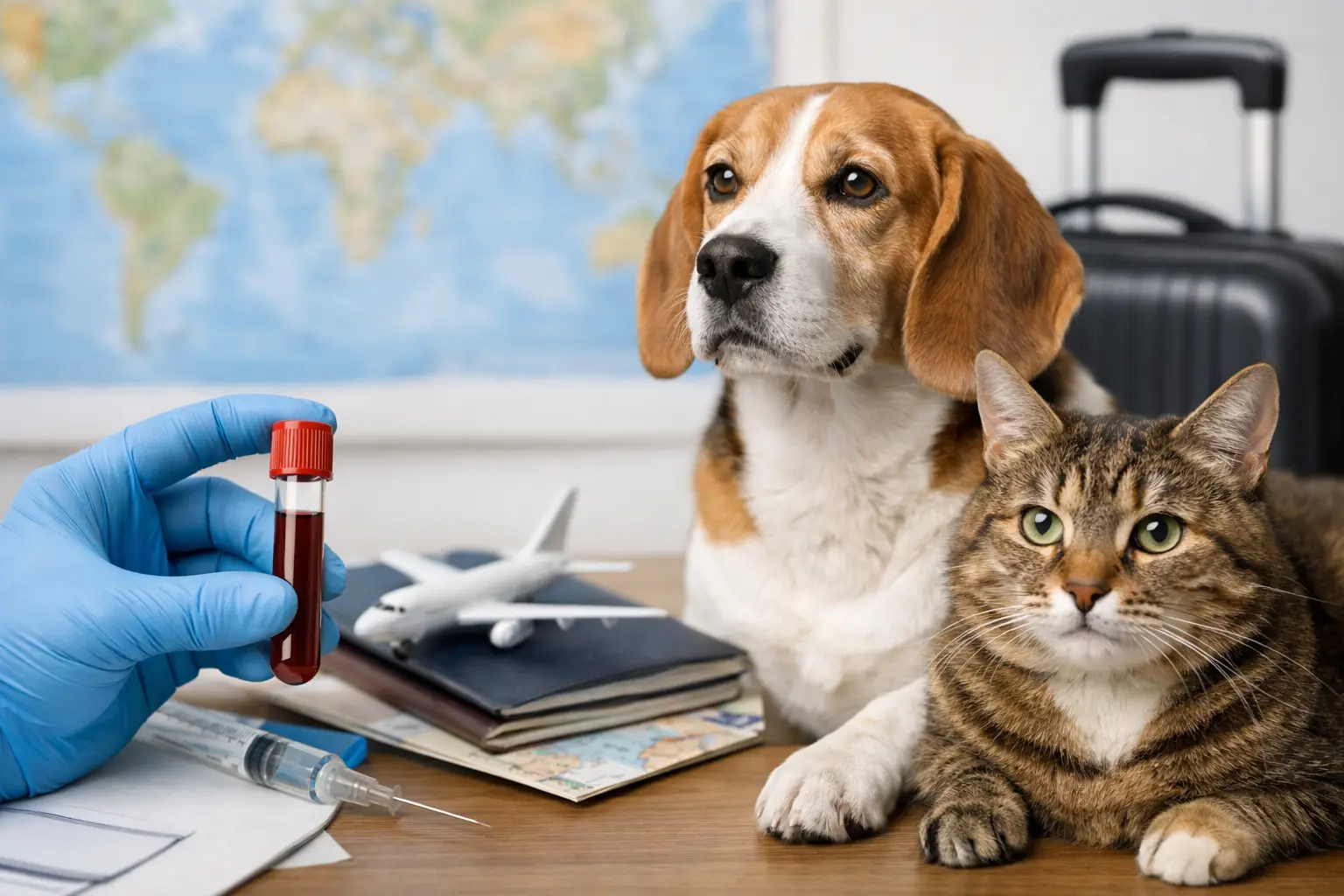
A rabies vaccine record alone is not always enough to clear your pet for international travel. For pet parents researching countries requiring rabies titer test documentation, the difficult part is rarely the blood draw itself. It is understanding whether the test applies to your exact route, where the sample must be processed, and how long you must wait before your pet can travel.
A titer requirement can affect your departure date by months. Planning it early protects your pet from avoidable boarding, denied entry, quarantine, or a last-minute change in travel plans.
What a rabies titer test proves
A rabies titer test, often called a rabies antibody test, measures the level of rabies-neutralizing antibodies in a blood sample after vaccination. The result helps a destination country confirm that a pet has responded appropriately to a valid rabies vaccine.
For international pet travel, the test is usually completed through an approved laboratory. A veterinarian draws the blood after reviewing the vaccination history, then sends the sample for analysis. Many destinations require a result of at least 0.5 IU/mL, but the numerical result is only one piece of the compliance process.
The rabies vaccination must be current and properly documented before the blood draw. In many cases, the pet must also have an ISO-compatible microchip implanted before the rabies vaccination or, at minimum, before the titer process begins. If the timing or document sequence is wrong, a passing result may not be accepted.
Which countries require rabies titer test records?
There is no reliable one-line list that applies to every traveler. Requirements depend on the destination, the country where your pet has been living, the country of departure, and sometimes every transit point on the itinerary.
Several destinations are well known for using rabies antibody testing as part of their import process. Australia, New Zealand, Japan, Singapore, Taiwan, and certain island destinations often have detailed titer and waiting-period rules. The United Arab Emirates and other countries in the Middle East may require titers depending on the pet’s country of origin.
The European Union also requires rabies antibody testing in specific situations. A dog, cat, or ferret entering from an unlisted country may need a passing titer test before travel. Pets arriving from countries on the EU’s listed-country schedule may have a different path, often based on microchip identification, valid rabies vaccination, and an official health certificate. The distinction matters greatly for families relocating through Central America, Latin America, or other regions that may be treated differently under EU rules.
Some countries do not ordinarily require a titer for standard dog or cat imports but may require it when a pet is arriving from a country classified as having higher rabies risk. Others can impose extra conditions after a change in rabies status, an outbreak, or a revised import policy. That is why destination research should be tied to your pet’s real itinerary rather than a generic internet checklist.
Panama generally does not use a rabies titer test as a routine import requirement for dogs and cats. However, a pet continuing from Panama to another destination may need one, and the correct testing timeline should be built into the relocation plan before the move begins.
Your route can change the answer
A family moving from the United States to Panama may face a very different set of requirements than a family moving from Panama to Spain, or from Colombia through Panama to Australia. The pet’s residency history can matter as much as the flight departure airport.
Transit rules deserve attention, too. A simple connection is often less complicated than an overnight stay or an airport transfer that requires the pet to enter the transit country. Airline routing can also change during the planning process, so the documents should be checked again whenever the itinerary changes.
The waiting period is usually the real challenge
For many titer-regulated destinations, the blood sample cannot be drawn until a specified period after the rabies vaccination. After the laboratory reports a passing result, another mandatory wait may apply before the pet is eligible to enter.
The best-known example is the EU process for pets entering from certain unlisted countries: a pet generally must wait three months from the date the blood sample was drawn before entering. That means a family cannot simply schedule a test a few weeks before a move and expect the pet to travel on the same date.
Other destinations use longer or more complex timelines. Australia and New Zealand may require advance preparation that spans many months, along with import permits, approved laboratory testing, specific parasite treatments, and carefully timed veterinary examinations. A titer result does not replace those steps.
There is one encouraging detail: when a pet maintains uninterrupted rabies vaccination coverage, an accepted titer result may remain valid for future travel in some jurisdictions. A gap in vaccine coverage can reset the process. Keeping every rabies certificate, laboratory report, and microchip record in a secure file is one of the simplest ways to preserve future travel options.
How to prepare without risking an invalid test
Start by confirming the destination’s current import protocol and identifying the rule that applies to your pet’s origin country. Then work backward from the desired arrival date. This approach is safer than choosing a flight date first and trying to make the veterinary timeline fit.
Before booking the blood draw, confirm the microchip number matches every existing record. Review the rabies certificate for vaccination date, manufacturer, expiration date, and veterinarian details. If your pet received the vaccine before being microchipped, ask whether the destination will accept that sequence. Rules differ, and assumptions can be costly.
The laboratory also matters. Certain destinations accept results only from designated or internationally approved labs. Sending a sample to the wrong lab can lead to a result that is medically valid but unusable for travel purposes.
Once the result arrives, check the full report rather than looking only at the antibody value. Names, microchip numbers, sample dates, laboratory identification, and signatures or endorsements must align with the rest of the travel file. Small discrepancies are often correctable, but they take time that international moves rarely leave to spare.
Common mistakes that delay pet travel
The most frequent problem is beginning too late. Pet parents may hear “rabies titer” and assume it is a quick veterinary appointment, when the requirement can include vaccination lead time, laboratory processing, and a post-test waiting period.
Another common issue is treating a titer test as a universal rule. Testing may be unnecessary for your route, while another document, permit, or treatment has a tighter deadline. Unneeded testing can add expense and confusion, but skipping a required test can stop the relocation entirely.
Documentation errors also create risk. A transposed microchip digit, an expired rabies vaccine, or a certificate issued in the wrong format can complicate airline acceptance or border inspection. Pet travel documentation is interconnected. Each record needs to support the next one.
Finally, do not rely on a previous pet’s paperwork or a friend’s travel experience. Requirements can vary by species, origin, destination, and date of travel. A rule that worked last year may no longer apply to your pet’s journey.
When professional planning makes a difference
Titer-test destinations reward early, coordinated planning. The veterinary schedule, laboratory submission, government endorsements, airline reservation, crate preparation, and final health certificate all need to work together. If one deadline shifts, the rest of the plan may need adjustment.
For complex relocations into, out of, or through Panama, Panama Pet Relocation can coordinate the travel sequence and help families understand where a rabies titer fits into the larger process. That support is especially valuable when a pet’s route includes multiple countries, a strict destination timeline, or a long wait between testing and travel.
Your pet does not need to experience your relocation as a rush of forms, airport changes, and unanswered questions. Start with the destination rule, protect the vaccination timeline, and give the titer process the time it deserves. A well-planned schedule lets you focus on the more meaningful part of the move: arriving together.