



Rabies Antibody Test for International Pet Travel
August 3rd, 2026 | Uncategorized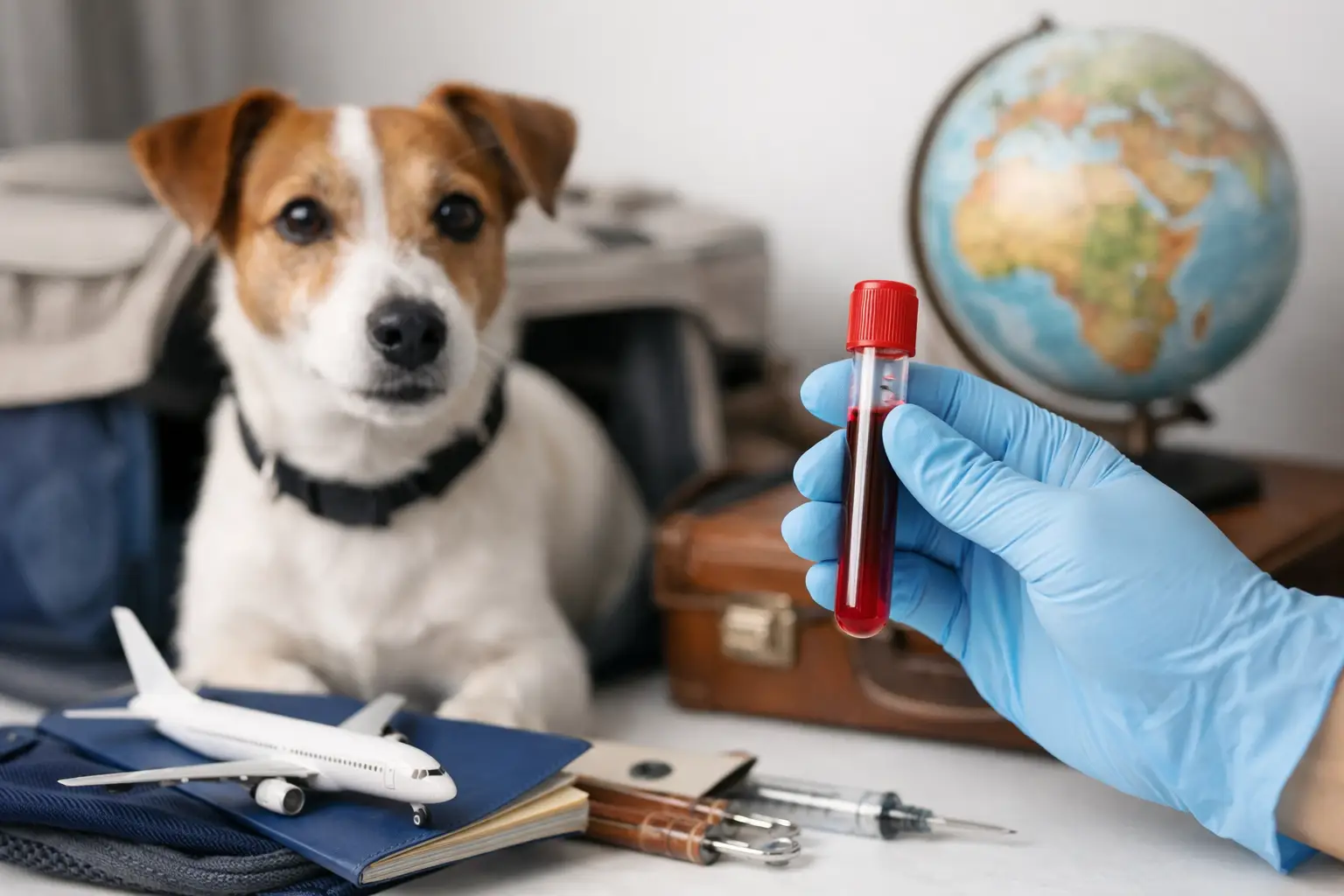
A rabies antibody test can be one of the most time-sensitive steps in an international pet move. Families often learn about it after booking flights or scheduling a final veterinary visit, only to find that the test result and required waiting period may determine whether their pet can travel on the intended date. When your dog or cat is moving across borders, early planning protects both your timeline and your pet’s comfort.
The test is commonly called a rabies titer test, and some countries specifically require a FAVN test or another approved rabies neutralizing antibody test. It measures whether your pet has developed an adequate immune response after rabies vaccination. It is not simply another vaccination record, and it does not replace the health certificate, import permit, airline requirements, or other travel documents.
What Is a Rabies Antibody Test?
A rabies antibody test is a blood test performed after a qualifying rabies vaccination. A veterinarian collects the blood sample and sends it to an approved laboratory, where technicians measure the level of rabies antibodies in the sample.
For many international destinations, the result must meet a minimum antibody level. A result of 0.5 IU/mL is commonly used as the benchmark, but the acceptable testing method, laboratory, vaccination history, and timing rules depend on the destination country. The details matter. A passing result does not automatically make a pet eligible to enter every country.
The purpose of the test is to help destination authorities manage rabies risk. From a pet parent’s perspective, it is best understood as a travel compliance requirement with a strict calendar attached to it.
When Does Your Pet Need a Rabies Antibody Test?
Not every international move requires a titer test. Requirements vary by destination, country of origin, transit points, species, and the pet’s previous travel history. Some countries accept a current rabies vaccination alone. Others require an antibody test only for pets arriving from certain countries. Still others require both a successful result and a waiting period that begins on the date the blood was drawn.
This is why a family should never assume that a test completed for a previous move will meet the requirements for a new journey. The destination may require a specific laboratory, a particular test type, an original laboratory report, or a defined period between sampling and arrival.
A rabies antibody test may also be necessary when a pet is returning to a country after time abroad. For example, a pet that traveled from one location with relatively simple entry requirements may face a much stricter process when entering the next country on the itinerary. Transiting through an airport usually does not create an import requirement, but extended transits, changes in travel plans, or temporary entry can affect the documentation needed.
For relocations involving Panama, Central America, the United States, Europe, island nations, or multiple flight segments, the right answer is always based on the complete route, not just the final destination.
The Timeline Matters More Than Most Families Expect
The test itself is straightforward. The timing is where international travel becomes complicated.
First, your pet must have a valid rabies vaccination. For a first-time vaccination, many countries require a waiting period before the blood sample can be collected. The sample is then sent to an approved laboratory, where processing times can vary. After a passing result is issued, the destination may impose another waiting period before travel is allowed.
In some cases, that final waiting period is measured from the blood draw date, not the date the result arrives. That distinction can be decisive when a move is approaching. A family may receive a favorable result quickly but still be unable to travel for weeks or months under the destination’s rules.
A simple delay can also have a chain reaction. If a rabies vaccine lapses, a country may treat the next vaccination as a primary vaccine rather than a booster. That can restart required waiting periods and affect when the sample can be drawn. If the laboratory result is below the required level, the pet may need revaccination and retesting, which adds more time.
For this reason, it is wise to begin reviewing travel requirements as soon as an international move becomes likely, ideally well before flights, housing, and final departure arrangements are fixed.
A typical testing sequence
The exact sequence changes by country, but the process usually follows the same general order: confirm the destination rules, verify the rabies vaccination record, wait any required period after vaccination, collect the blood sample, send it to an accepted laboratory, receive the result, complete any required post-test waiting period, and assemble the remaining travel documents.
Each date should be checked against the destination’s current rules. A document that is accurate but issued too early or too late can still cause a problem at airline check-in, customs, or arrival inspection.
What Can Cause a Test or Travel Plan to Go Wrong?
The most common problems are administrative rather than medical. A pet may have sufficient antibodies but still face a travel delay because the wrong vaccination date was listed, the microchip was not recorded consistently, the sample was submitted too early, or the laboratory report does not meet the destination’s format requirements.
Microchip details deserve special attention. Many countries require the microchip to be implanted before the rabies vaccination that supports the test. If the chip number on the vaccination certificate, laboratory report, health certificate, and import permit does not match exactly, authorities may question the pet’s identity and vaccination history.
It is also risky to schedule travel based only on an estimated laboratory turnaround time. Laboratories may experience high sample volume, holidays, shipping disruptions, or the need to clarify submission paperwork. A little margin in the schedule can prevent a stressful last-minute change.
Four practical habits reduce avoidable issues:
- Keep clear copies of every rabies certificate, including vaccine manufacturer, lot number, administration date, expiration date, and microchip number.
- Confirm that the veterinarian and laboratory are acceptable for the destination before the sample is taken.
- Treat the blood draw date as a critical travel date, especially if a waiting period follows it.
- Check the rules for every country involved in the itinerary, including any place where the pet may enter or remain during a disrupted journey.
A Passing Result Is Only One Part of Pet Travel Compliance
It is understandable to feel relieved when the laboratory report shows a passing result. Still, the titer is only one part of a larger travel file. Depending on the route, your pet may also need an import permit, an official veterinary health certificate, parasite treatments, government endorsement, an airline-approved travel crate, and carefully coordinated flight arrangements.
These requirements often work on different timelines. A titer may need to be completed months ahead, while a health certificate may only be valid for a few days. An import permit may require advance approval, while airline reservations can be limited by aircraft type, weather restrictions, or seasonal capacity. Managing the sequence is what keeps the move organized.
This is particularly valuable for families making a permanent relocation. Your pet is not cargo in the emotional sense of the journey. They are part of the household, and they need a plan that accounts for safety, paperwork, travel comfort, and what happens after arrival.
How Professional Coordination Helps
International pet relocation professionals can review the route and build a timeline around the requirements that take the longest. This may include coordinating with your veterinarian on vaccination and blood collection timing, confirming the appropriate laboratory process, tracking required waiting periods, and aligning the documents with airline and destination requirements.
At Panama Pet Relocation, this planning is approached as a full travel process rather than a single test or form. That means looking ahead for timing conflicts before they affect your departure date and helping families understand which dates cannot move once the process begins.
The best next step is to gather your pet’s current rabies certificate, microchip information, prior titer results if available, proposed travel date, and complete itinerary. With those details in hand, you can determine whether a rabies antibody test is needed and give your pet’s move the time and care it deserves.