


A missed vaccine date, an incorrect microchip number, or a health certificate issued one day too early can stop a pet’s journey before it begins. Learning how to move pets internationally means planning for much more than a flight. It means coordinating veterinary care, government requirements, airline rules, safe travel arrangements, and arrival procedures around one goal: getting your pet to their new home safely and without avoidable delays.
For families moving to, from, or through Panama and Central America, the details can feel especially demanding because each country, airline, and connection point may apply different rules. The right plan replaces last-minute uncertainty with a clear timeline.
How to move pets internationally: start with the destination rules
Every international move begins with the destination country’s import requirements. These rules determine which vaccinations, parasite treatments, tests, permits, and health documents your pet needs. They can also determine whether your pet may travel in cabin, as checked baggage, or as manifested cargo.
Do not rely on a friend’s recent experience or a general checklist found online. Requirements change, and they vary by species, country of origin, travel route, and sometimes even the pet’s age. A dog relocating from the United States to Panama may need a different process than a dog traveling from Panama to the United States, Colombia, or Europe.
Some destinations require advance import authorization. Others require government endorsement of a veterinary health certificate shortly before travel. Rabies-controlled destinations may require a rabies antibody titer test, often called a FAVN test, followed by a waiting period. If that waiting period applies, a move planned for next month may need to be postponed.
Start checking requirements as soon as your relocation becomes likely. Three to six months of lead time is sensible for many moves, while rabies titer destinations and complex routes may require longer.
Build a veterinary timeline, not a pile of paperwork
International travel documents are only valid when the medical steps behind them were completed in the correct order. That is why a timeline matters more than collecting forms at the last minute.
First, confirm that your pet has an ISO-compatible microchip, if required by the destination. The microchip should be scanned and recorded before rabies vaccination whenever regulations require that sequence. A rabies vaccine administered before a qualifying microchip may not count for import purposes, even if your pet is fully protected medically.
Next, review core vaccines, parasite treatments, and any destination-specific testing. Your veterinarian should be involved early, but a regular veterinary appointment alone does not guarantee compliance with international rules. The health certificate may need exact wording, specific treatment dates, laboratory results, or official government certification.
Keep a single, accurate record of every item: microchip number, vaccine manufacturer, lot number, administration date, expiration date, laboratory report, and signed certificate. Small inconsistencies can create problems at airline check-in or border inspection. If your pet has a medical condition, discuss fitness to fly with your veterinarian well before travel. Sedation is generally not recommended for air travel unless a veterinarian has advised it for a specific reason, as it can affect balance and breathing at altitude.
Why timing causes so many problems
Health certificates often have a narrow validity window. A certificate may need to be issued within a set number of days before departure, yet it cannot be prepared until all vaccines, treatments, and permits are in place. Flight changes can therefore affect document validity.
This is where experienced coordination matters. The travel date, veterinarian appointment, government endorsement, airline booking, and customs arrangements should support the same timeline. Treating them as separate tasks is how families end up rushing to solve a problem days before departure.
Choose the safest practical travel arrangement
There is no single best way for every pet to fly internationally. The right arrangement depends on the animal, route, airline policy, weather, aircraft type, and destination procedures.
Small pets may be eligible to travel in the cabin in an airline-approved carrier, provided the airline and destination allow it. This keeps the pet close to the owner, but cabin space is limited, not every route permits animals, and the carrier must fit beneath the seat.
Larger dogs often travel in a climate-controlled area of the aircraft as checked baggage or cargo. Cargo is not automatically less safe. For many international moves, it is the only compliant option, particularly when a pet is traveling separately from its owner, exceeds cabin size limits, or is moving under destination import rules that require cargo handling. The key is selecting a suitable airline, an appropriate route, and a correctly sized travel kennel.
Whenever possible, choose a direct flight. Each connection adds handling, timing risk, and potential exposure to weather restrictions. A direct route may not always be available or appropriate, especially for travel across Central America or to remote destinations. In that case, the connection needs to be planned around minimum transfer times, transit-country requirements, and the airline’s pet-handling procedures.
Get the travel kennel right
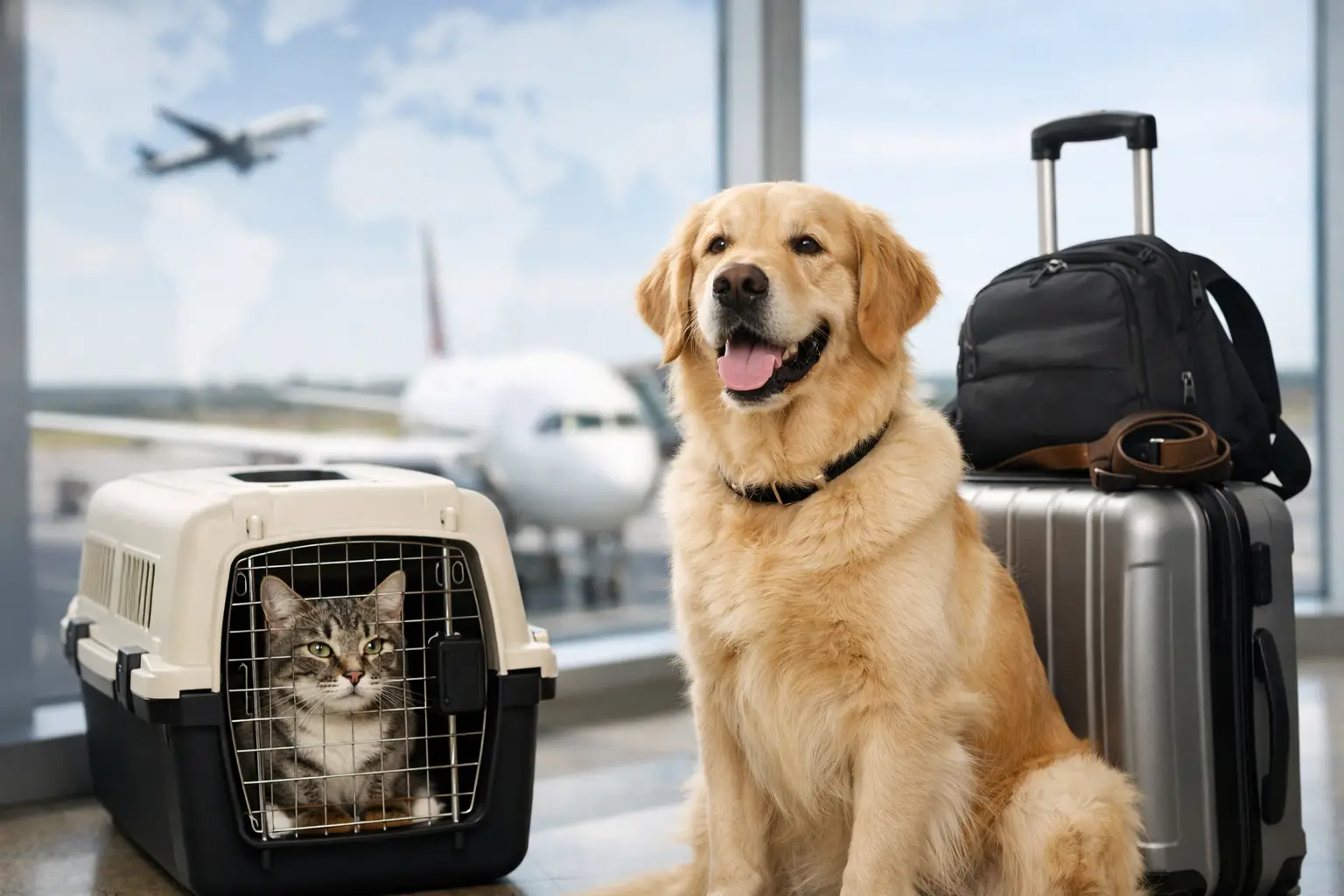
The kennel is your pet’s travel space, so size and construction are not minor details. It must meet airline standards and allow your pet to stand naturally, turn around, and lie down comfortably. The door must fasten securely, ventilation must be adequate, and the kennel should be clearly labeled with your pet’s information and the owner’s contact details.
Help your pet become comfortable with it before travel. Leave the kennel open at home, add familiar bedding if permitted, and use calm, positive practice sessions. A pet that sees the kennel as a familiar resting place is more likely to travel with less stress than one introduced to it at the airport.
Prepare for airport and customs handoff
Departure day should not be the first time you check the paperwork. Review every original document in advance and carry copies separately. Airlines may have their own check-in requirements beyond the destination’s import rules, including earlier arrival times, kennel inspections, and booking confirmations for live animals.
At arrival, your pet may be released through baggage claim, a cargo facility, or an agricultural inspection area. Customs clearance can involve document review, a pet examination, payment of applicable government charges, and confirmation that the animal matches the records. A compliant pet can still experience delays if the receiving process has not been arranged correctly.
This is particularly relevant in Panama, where import documentation, airport handling, and customs coordination must align with the pet’s actual arrival time. For owners who are managing a household move, a new job, or a cross-border transition at the same time, professional support can remove the pressure of coordinating every handoff alone. Panama Pet Relocation manages end-to-end travel planning, documentation, airline routing, customs clearance, and delivery for pets moving locally, regionally, and worldwide.
Plan around your pet, not just your moving date
A compliant trip should also be a humane one. Consider your pet’s temperament, age, breed, health, and routine. Brachycephalic breeds, including some short-nosed dogs and cats, may face additional airline restrictions because of respiratory risks. Very young, elderly, anxious, or medically complex pets may need a more tailored travel plan.
Avoid changing food suddenly before travel, and confirm feeding instructions with the airline or transport provider. A light meal at an appropriate time is often better than a large meal immediately before departure, but individual needs vary. Provide water according to airline requirements and make sure your pet has had exercise and a bathroom break before check-in.
Birds, exotic animals, and wildlife require an even more specialized process. Their travel may involve species permits, protected-species documentation, specialized containers, quarantine requirements, and airline acceptance rules that do not apply to dogs and cats. These cases should be assessed well in advance, not added to a general pet travel plan at the last minute.
Know when professional help is worth it
Some straightforward trips can be managed independently when the route is direct, regulations are simple, and the owner has time to verify every requirement. But professional assistance is especially valuable when a move involves multiple countries, cargo travel, a tight timeline, a rabies titer requirement, a pet traveling separately from its owner, or customs clearance on arrival.
The practical benefit is not only convenience. A qualified pet relocation team can identify timing conflicts before they become missed flights, confirm routing that matches airline and import rules, and keep documents organized through each stage of the move. That reassurance matters when the traveler is a family member who cannot explain what went wrong.
Your pet does not need a perfect trip to have a safe, well-managed one. They need a plan built early, checked carefully, and carried out by people who understand that a calm arrival is the first good day in a new home.